
Why AI is the Only Way to Save Your Wine Club from Churn
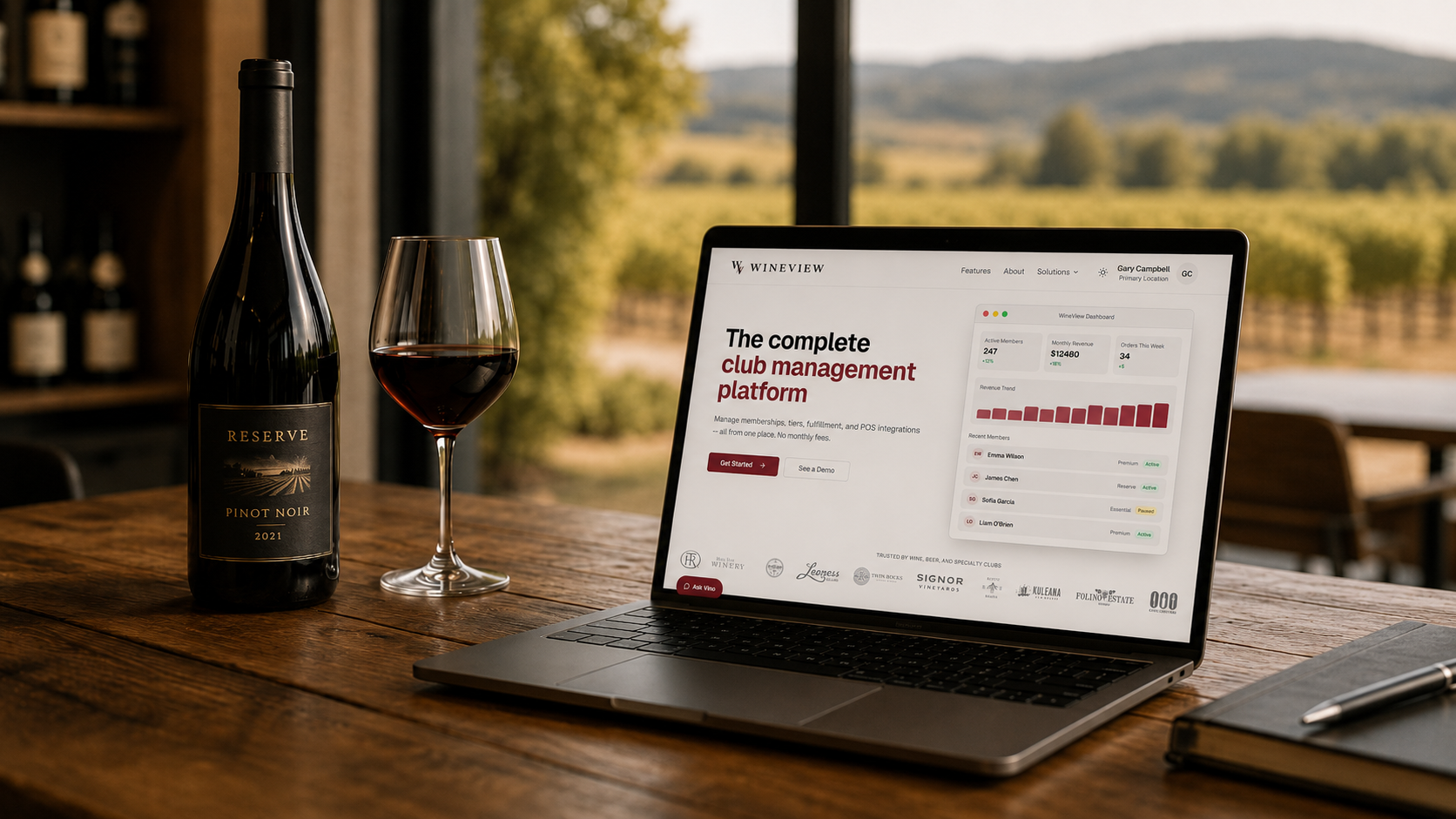
The Hard Truth: Why Traditional Wine Clubs Are Failing
Wine clubs are hemorrhaging members — and the old playbook is no longer working. Consumer expectations have shifted dramatically, and the gap between what modern wine drinkers want and what most clubs actually deliver has grown into a chasm that good intentions alone cannot bridge. According to the DTC Wine Symposium, traditional wine club models face a genuine crisis of declining retention as consumers demand increasingly personalized experiences.
The core problem is a stubborn reliance on uniformity. Most clubs still operate on a "curate once, ship to everyone" model — the same wine selection going to every member each quarter, regardless of what that member actually enjoyed on their last visit. When a member who prefers Pinot Noir receives their third consecutive red blend, they do not call to complain. They cancel. And because the data that could have prevented that cancellation was sitting in a disconnected system — various disconnected systems — nobody caught the signal in time.
That operational fragmentation is where the real cost accumulates. Disconnected tools force staff to reconcile data manually, which introduces errors, delays, and blind spots. Even wineries investing in winery marketing automation often find that automation without intelligent data routing simply moves the wrong information faster. The member record exists, but nobody is acting on it — and that gap between having data and doing something useful with it is precisely where churn is born.
Understanding why that gap persists requires a closer look at how the right technology can close it.
From Data to Action: How AI Transforms Club Management
AI-driven wine club management goes beyond generating reports — it is about triggering the right action at the right moment, automatically.
Most wine club software stops at the insight layer. It tells you what happened: how many members canceled last quarter, which SKUs moved, where revenue dipped. That information has value, but it arrives too late. The decision has already been made by the member. What operators actually need is a system that moves from passive reporting to proactive intervention — and that is precisely where AI earns its place.
The 'action layer' is what separates a modern AI engine from a conventional CRM dashboard. As Gartner notes, "the value of AI extends beyond the insights it generates, but in its ability to automate the 'next best action' for the business owner." In practice, this means the software does not wait for a manager to notice a trend. It identifies the signal and responds — whether that is adjusting a shipment preference, flagging a lapsed engagement, or queuing a personalized outreach message.
One area where this gap is especially visible is point-of-sale integration. When your tasting room POS connects directly to your club platform, every transaction becomes a data point: visit frequency, average spend, varietal preferences, even time-of-day patterns. Without AI, that data sits in separate systems, reconciled manually at month-end. With it, member behavior informs real-time decisions — and the administrative overhead of cross-referencing systems shrinks considerably.
Reduced administrative burden is an underrated benefit of this approach. Staff time currently spent on manual reconciliation, shipment audits, and member lookup can be redirected toward genuine hospitality. According to research on AI in the wine industry, wineries that adopt intelligent cellar and club software consistently report operational efficiency gains alongside improved member experience — not as separate outcomes, but as the same outcome.
The shift, then, is structural. AI does not replace the human judgment that makes a wine club worth joining. It removes the friction that prevents that judgment from being applied where it matters most. And once you have a system that can act on data in real time, the next question becomes: can it tell you who is about to leave before they do?
Predictive Analytics: Stopping Churn Before It Happens
Predictive analytics answers the most pressing question in wine club management today: why is AI important for wine club retention, and can it act fast enough to matter?
The answer is that it can — but only when it operates on real-time signals rather than end-of-month summaries. By the time a traditional report flags a member as disengaged, that member has already mentally canceled. AI-powered predictive analytics can identify 'at-risk' club members by analyzing behavioral patterns before they cancel, allowing the system to trigger a response while the relationship is still salvageable.
The scenario plays out like this: A member who once purchased two additional bottles per quarter suddenly goes silent. No tasting room visits. No email opens. No add-ons. To a human manager reviewing monthly spreadsheets, this looks like a quiet account. To a predictive model reading purchase frequency, engagement cadence, and tasting room activity in real time, it is a clear early-warning signal.
Once that signal fires, automated retention actions deploy immediately:
- A personalized discount on a wine matched to their previous purchase history
- A handwritten-style note from the winemaker acknowledging their loyalty
- An invitation to an exclusive member event tied to their preferred varietals
- A shipment customization prompt that gives them control before the next release
Retention is often more cost-effective than acquisition — and that gap widens considerably in the wine club space, where a single loyal member may generate thousands of dollars in lifetime value. Winning back a lapsed member requires rebuilding trust from scratch; keeping one requires a well-timed nudge.
The data feeding these interventions becomes even sharper when tasting room behavior is connected directly to club records. When your tasting room transactions sync in real time with member profiles, the predictive model gains the full picture — not just what someone buys online, but what they reach for when they are standing at the bar. That complete behavioral profile is exactly what the next layer of AI-driven strategy depends on: matching every shipment to individual taste so precisely that skipping it simply does not cross a member's mind.
Hyper-Personalization at Scale: The New Industry Standard
Personalization has become a standard expectation — it is the baseline expectation that separates wine clubs members stay in from ones they quietly abandon. Epsilon research found that 80% of consumers are more likely to make a purchase from a brand that provides personalized experiences. For wine clubs, where a skipped shipment is often the first step toward cancellation, getting the right bottle to the right member is a direct retention strategy.
AI wine club software benefits are most visible here: when the system knows what a member loves, it curates shipments they actually want to open.
The connection between tasting room behavior and club fulfillment has historically been a blind spot. A member raves about a bold Zinfandel at the bar, then receives a delicate Pinot in their next shipment — and skips it. Syncing point-of-sale data from platforms like Toast closes that gap automatically, feeding real purchase history and tasting room preferences into the curation engine without any manual data entry required.
| Factor | Manual Curation | AI-Driven Curation |
|---|---|---|
| Data inputs used | Staff memory, basic notes | POS history, flavor profiles, skip patterns |
| Consistency | Variable | Systematically applied every cycle |
| Scale | Limited by staff time | Handles thousands of members simultaneously |
| Skip rate impact | Minimal | Measurably reduced through better matching |
| Update frequency | Periodic, manual | Continuous, real-time |
What this means in practice is fewer skipped shipments, stronger perceived value, and members who feel understood rather than processed. And because the system updates preferences continuously — not just at sign-up — it adapts as tastes evolve. That kind of dynamic, self-correcting personalization is what drives the revenue gains the next section examines in detail.
The ROI of Automation: More Revenue, Less Overhead
Automation does not just save time — it directly converts operational efficiency into measurable revenue gains that compound month over month.
Targeted marketing powered by predictive analytics for wine clubs can lift sales by 10% or more, and Harvard Business Review research shows AI-driven personalization delivers five to eight times the ROI on marketing spend. That math changes the conversation from "can we afford AI?" to "can we afford not to use it?" When your club is sending the right offer to the right member at the right moment — automatically — every marketing dollar stretches further than any batch-and-blast email campaign ever could.
The "software tax" is a real cost most owners underestimate. Monthly subscription fees for separate CRM, email, fulfillment, and analytics tools stack up quickly, often exceeding $500–$1,000 per month before a single shipment goes out. No-monthly-fee models eliminate that overhead entirely, keeping margin where it belongs — in your winery.
Scaling recurring revenue without adding headcount is where automation earns its clearest return. Fulfillment workflows, shipping label generation, and club cycle management run on logic, not labor. A club processing 500 shipments operates with the same back-office effort as one processing 50. And when efficiency compounds across both marketing and operations, the bottom line shifts in ways that are difficult to achieve through any other single investment — a point the next section addresses directly.
The Bottom Line: Why Your Club Needs an AI Engine
Wine club survival in a competitive market comes down to one question: are you acting on your member data, or simply collecting it?
AI is what closes that gap — transforming static purchase histories and behavioral signals into immediate, revenue-generating actions. Without an intelligence layer, even the richest dataset sits idle while members quietly drift toward cancellation. The sections above have shown how personalization drives retention and how automation converts operational efficiency into compounding revenue. What ties those capabilities together is a coherent AI engine working continuously beneath the surface.
Predictive analytics are now the only reliable defense against churn. Reactive outreach — contacting a member after they have already disengaged — recovers a fraction of what proactive intervention does. AI flags at-risk members weeks before they cancel, giving your team a real window to act. And the scale of that responsiveness matters: according to Drinks.com, wineries using AI-powered automation have cut customer response times by 90% during peak seasons.
Personalization, as covered earlier, is no longer a differentiator — it is the floor. Members expect allocations, communications, and offers tailored to their preferences. Clubs that still send generic shipments are not competing; they are eroding trust with every impersonal interaction.
None of this works without accurate, real-time data at the foundation. Deep POS integration — particularly with systems like Toast — ensures the AI is reading current purchase behavior, not lagging snapshots. That accuracy is what makes predictions trustworthy and actions effective. Choosing the right platform to unify these capabilities is the logical next step.
Future-Proofing Your Membership with WineView
The fastest path to sustainable wine club growth is eliminating the gap between your data, your tools, and your decisions. Disconnected tech stacks create exactly that gap — purchase data lives in one system, membership records in another, and email campaigns in a third. By the time your team reconciles all three, a high-value member has already quietly canceled. All-in-one platforms remove that lag entirely, giving every function access to the same real-time picture.
Real-time Toast POS sync is where data accuracy becomes a competitive advantage. When a member's in-person purchase registers instantly against their club profile, your segmentation, reorder triggers, and retention flags all update without manual intervention. That accuracy is what separates a genuinely intelligent membership engine from a glorified spreadsheet with an automation layer on top.
WineView was built around this principle — a native Toast POS integration combined with a zero-monthly-fee pricing model that makes scaling straightforward. As your membership grows, your overhead does not have to grow with it. The platform is structured to support more members, more segments, and more automated workflows without adding headcount or complexity.
Churn can be addressed as a data problem, and the right platform solves it before a cancellation ever reaches your inbox. For achieving recurring revenue goals, automation is essential — it is the infrastructure. Start building that infrastructure today and give your wine club the engine it needs to grow.
Key Winery Marketing Automation Takeaways
- A personalized discount on a wine matched to their previous purchase history
- A handwritten-style note from the winemaker acknowledging their loyalty
- An invitation to an exclusive member event tied to their preferred varietals
- A shipment customization prompt that gives them control before the next release
- Wine clubs are hemorrhaging members — and the old playbook is no longer working.